
Live stories. Every single day.

Oh, you're here again, my friend. Have a seat and enjoy a good read.

We're still building the site — thanks for being here early.

Popular

Our most-read stories of all time

Giulia just wanted to wash her hands in the library restroom, but she ran into a new automatic soap dispenser that operated by its own peculiar rules: it dispensed soap only after she pulled her hand away.

She held her palm under the nozzle—silence. She moved closer and waited. But the moment she sharply withdrew her hand, the device spat a glob right into the empty sink. Her second attempt was strategic: hand under the sensor, a brief pause, a quick retreat. This time, the soap landed directly on her sleeve. The machine clearly acknowledged her presence, but refused to cooperate normally.

For her third attempt, Giulia placed one hand underneath and the other to the side to catch the drop. When nothing happened, she leaned in close to inspect the LED light. At that exact second, the dispenser triggered and squirted soap right onto her glasses.

Groping blindly, she rushed to the touchless tap, discovering it only flowed if she continuously waved her free hand in front of it. From the side, it looked as though she was tearfully bidding an overly dramatic farewell to someone.

Drawn by the commotion, the librarian walked in with paper towels and immediately solved the mystery: the sensor housing had been installed backward during morning maintenance.

Giulia thoroughly rinsed her glasses, spun the sensor around the right way, and held out her palm once more—the soap dropped neatly into her hand. Finally, she brought her soapy sleeve to the faucet, waved her other hand to trigger the water, and washed her cuff. Leaving the library, she decided to stick to traditional soap bars from then on—at least until her next restroom visit.


0 65

I took the rule for lost creatures too literally and stubbornly refused to leave the cardboard maze.

In my enclosure, I just wanted to retrieve an apple slice and head back to my favorite branch. Olena, my keeper, placed the treat between the boxes for an enrichment exercise, while a tour guide behind the glass instructed a group of children: “If you ever get lost, stay right where you are until someone finds you!”

I entered the maze, grabbed the apple, and turned around, but a cardboard flap dropped shut behind me. The way back was blocked. According to the human safety rule I had just heard, I was officially lost. So, I sat down right where I was and finished the apple—waiting for rescue is much nicer with a snack.

Seeing me stay put, Olena laid a grape by the exit, then a nut, thinking I didn't understand the game. I understood perfectly, but the safety instructions were clear, so I didn't budge. It became an evacuation with room service; I merely turned my head as a respectable feast piled up just out of reach.

When Olena brought my evening bowl, I decided to help the rescue team. Without shifting my hind paws, I braced the cardboard with my front paws and chewed a hole right through the wall. I poked my head out—now visible, my "lost" status was revoked.

I tore the hole wider and stepped out to my bowl, though a square piece of cardboard remained stuck around my neck like a collar. Turning my head sideways to keep it from dragging, I ate my dinner. I had followed the safety rule to the letter; nobody had promised it would be comfortable.

0 61

Taras usually worked remotely, but on Wednesday he decided to come into the company’s downtown open-space office for a change of scenery. The office operated on a hot-desking system: employees booked workstations through an app, while unreserved tables displayed double-sided plastic signs reading “AVAILABLE DESK.”

He took a spot by the window, opened his laptop, and shifted the sign to the edge of the desk to make room for his coffee. From the corridor, the sign angled so that the first word blocked the second, leaving only a bold “AVAILABLE” visible. In a corporate culture perpetually strapped for resources, that was more than enough.

A sales manager approached first, handing him a printout: “Taras, take a quick look at this presentation, since you’re available anyway!” Taras explained that the desk was available, not him, but she just smiled, left the file, and promised to return in fifteen minutes. Next came an accountant with a financial spreadsheet, followed by a designer asking him to evaluate three shades of blue for a new landing page.

After every visitor, Taras laid the sign flat, but an office manager passing by kept standing it upright again: hot-desking rules required every workstation’s status to be clearly visible from a distance.

By lunchtime, a polite queue had formed beside his desk. Taras turned the sign toward the window, but his colleagues simply walked around the table and lined up on the other side. He then hid it in a drawer. Ten minutes later, the administrator sent him a message in the team chat asking him “not to obscure official signage in unreserved zones.” Taras sighed, retrieved the sign, put it back, and opened his calendar to block out time for sign-ups, realizing that fighting open-space logic on his own was a losing battle.

The following Wednesday, Taras came to the office again. He placed “AVAILABLE DESK” right in the middle of the table and added a sheet next to it reading “Available Taras: 3:00 PM–4:00 PM,” complete with a sign-up sheet. His coworkers appreciated the structured approach and quickly filled the slots: the presentation, the report, the three shades of blue.

At four o'clock sharp, Taras crossed out the final name, tucked both signs into the drawer, and moved to the neighboring desk he had pre-booked in the app. There, he opened his own task list, finished his still-warm coffee, and finally settled in to work under the dependable protection of the word “OCCUPIED.”

0 60
Sponsored

Bohdan went to the supermarket for just milk and tea, but a faulty shopping cart decided to design his weekly menu on its own.

The front left wheel was jammed at an angle, so instead of moving straight, the cart immediately veered right into the produce section. Trying to correct its path, Bohdan yanked the handle, accidentally snagged a display, and sent a mesh bag of potatoes scattering across the floor. Gathering them up, he sighed and tossed them into the basket: returning them after such an ordeal felt overly formal.

At the dairy section, he had to juggle holding the door open with one hand while keeping the cart from wedging itself under a shelf. He managed to grab his milk, then jammed the tea box between the potatoes so it wouldn't slide around the empty cart.

To counteract the alignment issue, Bohdan placed a five-liter jug of water on the right side as a counterweight. The cart finally went straight, but now gathered alarming momentum. In the household aisle, the jug shifted, the cart veered sharply, and knocked down a tower of paper towels. Pinning the jug with his knee, Bohdan gathered the towels and added them to his load.

Then he tried a new approach: stepping in front of the cart, he pulled it behind him. Backward, it rolled smoothly and effortlessly.

Glancing over his shoulder, Bohdan guided it to the checkout and paid for his unexpected haul. That evening, he posted a review on the store’s page: “Spacious, sturdy, creates its own menu. Struggles going forward, flawless in reverse.” He awarded four stars and poured himself a glass of water. At least one impulse buy was already justifying its place on the receipt.

0 35

Lars the owl could no longer sit peacefully on his favorite observation pipe: a motion-sensor light had been installed right above it.

The pipe beneath the balcony was dry, high, and perfect for watching the courtyard. Lars just wanted an ordinary night out while the resident inside read quietly behind the glass door. But whenever Lars so much as turned his head, the bright lamp flashed on right above his beak, blinding him and annoying the human.

Lars froze, and the light went out. He leaned forward to check the flower bed—the lamp flashed again. After the third try, the resident stepped out in slippers, twisted the sensor, and went back inside. Lars cautiously shifted. The human reappeared, this time with a screwdriver, and aimed the sensor lower. Now it reacted not just to the owl, but to a lilac branch swaying in the slightest breeze.

Thanks to the wind, the light stayed on almost continuously, drawing a swarm of night moths to the bulb. Lars perched closer and began snatching them mid-air. Every flap of his wings kept the sensor triggered, luring in a fresh serving of dinner.

The resident peeked out three times, silently watching this illuminated feast, then returned with a stepladder and a roll of black electrical tape. Lars wisely flew over to the lilac branch: an owl may not understand home repairs, but he knows when a human has completely run out of patience.

The man taped over the sensor and went to bed. As the light went dark, the moths began to scatter. Lars returned to the pipe and spotted a loose end of tape hanging down. Gripping it in his beak, he pulled until it peeled completely off.

The lamp flashed back to life, the moths returned, and Lars settled in comfortably. His observation post was back in business—now with complimentary dinner service.

0 34

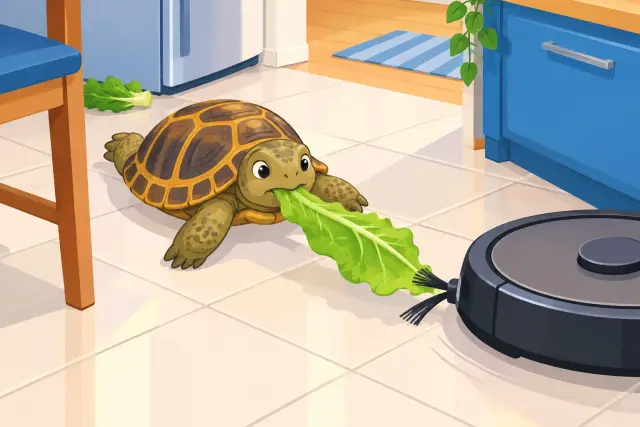
Klaus the tortoise lost control of his lunch the moment a robot vacuum snatched the lettuce leaf he was already chewing.

It had started as a routine morning: his owner, Oksana, placed a fresh leaf on the kitchen floor near the fridge for him and turned on the vacuum. Klaus just wanted a quiet meal, after double-checking along the way that the chair leg was still in its usual place. It was. It’s always nice when the furniture behaves predictably.

Klaus crossed two floor tiles and bit into the lettuce just as the vacuum turned near the cabinet. The robot’s side brush caught the opposite end of the leaf and dragged it toward the hallway. Klaus had to march right along behind it: letting go of food simply because it had suddenly started traveling felt like a hasty decision.

At the corner, Klaus swung sideways, his shell clicking over the tile grout. The spinning brush kept winding up the leaf, closing the distance between tortoise and machine. Finally, the vacuum bumped into his water bowl, flipped it over, and got stuck spinning its wheels in the puddle. The wheels slipped, but the brush kept pulling. Klaus planted all four feet into the wet floor and held on tight.

Drawn by the racket, Oksana arrived, switched off the vacuum, and carefully freed the lettuce from the brush. She rinsed it under the tap, set it back down near the fridge, refilled the water bowl, and wiped up the puddle.

Klaus waited until the tiles dried, casually ambled back along the same route, and sat down before his meal. This time, he methodically ate the leaf down to the stalk—at a speed entirely under his control.

0 33

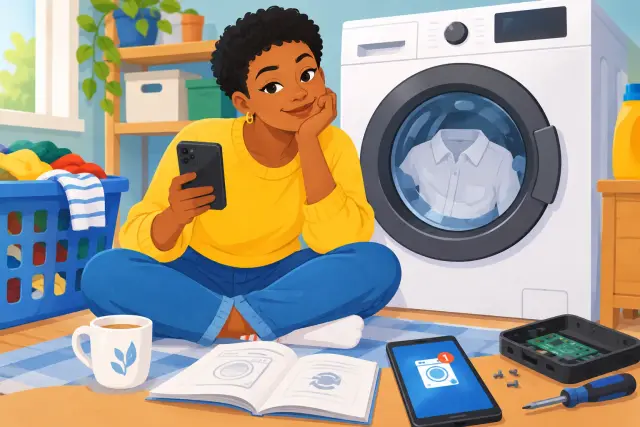
The smart washing machine locked Zainab’s favorite shirt inside its drum and kept extending the wash indefinitely, constantly finding excuses for extra cycles.

On Saturday morning, Zainab loaded the laundry, selected a thirty-minute quick cycle in the mobile app, and went to the kitchen for tea. When the display reached one minute, she returned to collect her clothes. Right in front of her, the timer suddenly reset to seven minutes—the intelligent sensor had decided the fabric wasn’t clean enough yet.

Seven minutes later, the drum stopped, but the latch didn’t click. A notification popped up on her phone: “Optimizing cycle. Determining moisture level.” Zainab tapped “End Cycle,” but the app threw an error and asked her to check the door. Her shirt lay behind the glass looking perfectly clean, but totally unreachable. Zainab opened the manual and performed a forced restart.

The machine drained the water and unlocked the door. But the moment Zainab reached for the handle, the lock clicked shut again. Over Wi-Fi, the app detected an “unfinished cycle” and automatically resumed the wash without waiting for her input. The drum began filling with water once more.

Zainab decided to take drastic action. She walked into the hallway, unplugged the Wi-Fi router, and cut the power to the machine. Deprived of its internet connection and electricity, the appliance finally surrendered. A minute later, the emergency latch released. Zainab opened the door, held a bowl under the trickling water, and pulled out her spotless shirt.

After hanging her clothes, she deleted the app and plugged the machine back in—but left the router off. Deprived of its smart network, the machine quietly displayed zero minutes. Zainab retrieved her cold tea from the kitchen and shut the bathroom door.

0 22

I tried so hard to impress the keeper with my tidiness that I buried my own sleeping spot under apples. The apples on the tree in my enclosure at the animal rescue centre were ripe, and I was planning a nap on my low wooden platform. The keeper came in to collect the windfalls and set a bucket beside the gate. I picked up an apple and put it on the platform: sometimes a fox wants praise for something other than not stealing. Especially when the human has arrived without a brush and isn’t in a hurry.

“Taras, you’re such a good helper,” she said, picking the apple up off the boards. That was enough. While she carried the full bucket out through the gate, I brought over a second apple, then a third. I carried them carefully, one at a time, so she could see she was dealing with a responsible fox, not simply someone with an available mouth. By the time she returned, there were so many apples on the platform that only my front paws would fit. The rest of me remained on the ground, although all of me had been planning to sleep.

The keeper crouched down to gather apples around the tree, and I decided to fix things before she noticed my awkward position. My wide, empty breakfast bowl was nearby. I nudged the nearest apple into it with my nose. It stayed put. Excellent: the bowl held fruit much better than flat boards did. I moved the rest into it, pushing the last one in with a paw while holding the rim steady with the other. The platform was clear again. There was even room for my tail. I checked this personally and had just started settling down.

Then the keeper brought breakfast. Seeing the full bowl, she put a puzzle feeder beside it and tucked the food into its holes: she would collect the apples after her rounds. I could have emptied the bowl again, but that would mean undoing my freshly completed tidying. So I chose the clean platform and breakfast with extra work attached. I lay on the boards and began fishing pieces out with a paw. The praise had stopped, but apparently my shift as a helper hadn’t.

0 14

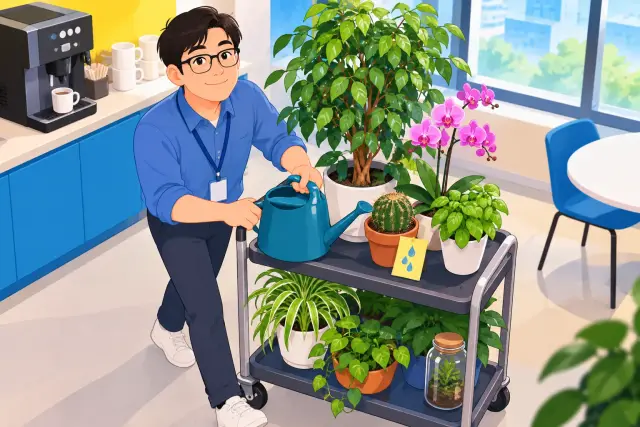
Mateo agreed to water a single office ficus, but his colleagues interpreted this as an official handover of the department's entire botanical inventory.

On Monday, he sat in a half-empty office trying to finish his quarterly report. Marta from finance was heading on vacation and asked him to splash some water on her ficus by the window once a week. Mateo agreed—one pot felt entirely manageable. He checked the watering routine, set a Friday reminder, and returned to his spreadsheets.

On Tuesday, Marta posted a thank-you note in the main team chat, mentioning that "the plants" were now in safe hands. Triggered by that innocent plural, a sales colleague showed up an hour later with a cactus and a note: “Two drops every Wednesday.” Before Mateo could clarify, others dumped an orchid, a basil pot, and a jar containing an avocado pit onto his desk, before promptly switching to remote work for the rest of the week.

On Wednesday, Mateo scheduled a calendar event titled “Collect Your Plant” to return the greenery. Seeing the invite, four more colleagues brought in their home pots, assuming it was a corporate plant swap. On Thursday, three owners joined the meeting online via video link, staring at their pots through the screen while unable to physically take them back.

With the aisle blocked, the office coordinator brought over a two-tiered utility trolley. Mateo arranged the pots, labeled them with a marker, and wheeled them to the kitchenette.

On Friday, armed with a jug, a measuring spoon, and a towel, he watered everything over the sink and trimmed the dry leaves. He returned the ficus to his desk, parked the trolley by the window, and renamed the event “Plant Patrol.” Finally having cleared his desk, Mateo calmly finished the quarterly report.

2 13

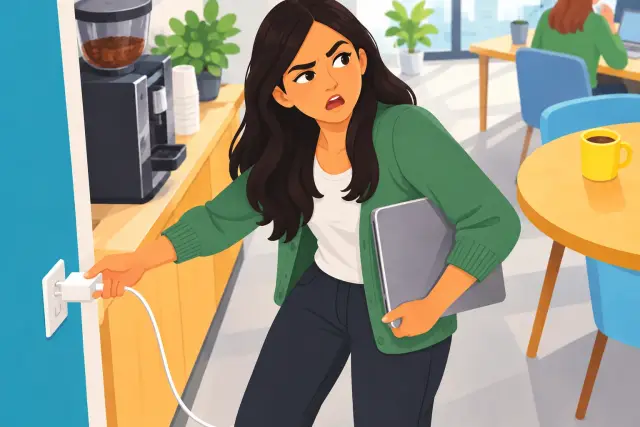
Tamara was leading an important online meeting from an empty office, but the motion sensors stubbornly assumed the building was deserted.

She had to present the new budget to upper management, so she set up in a glass conference room, placed her laptop on the long table, and clicked “Join.” Beyond the glass walls sat dark rows of desks and the coffee machine where she had already grabbed two double espressos for extra stamina.

On the third slide, the lights abruptly went out. Tamara apologized to the twelve faces on her screen, stood up, and waved her arms broadly. The sensor caught the movement, and the overhead lights flickered back on. But two minutes after she sat down, the room plunged into darkness again—the motion sensor simply refused to register a motionless person as an active employee. Tamara had to pace back and forth near the door while continuing her financial breakdown on the fly.

To stop pacing, she shifted her laptop closer to the sensor, where raising her arm every few minutes was enough. However, the video meeting software recognized the gesture and triggered the digital “Raise Hand” feature every time. The host kept interrupting: “Tamara, do you have a question?” She lowered her digital hand, returned to the slide, and waved her real hand a minute later as the lights began to dim again.

Finally, Tamara found a workaround: she took out her phone, switched on the flashlight, and pointed the beam at her face. No more gesturing was needed. She calmly walked through the final slides, got budget approval, and wrapped up right on schedule.

She turned off her flashlight, closed her laptop, and walked out. Behind her, the lights went dark once more—only this time, Tamara didn't bother proving her existence to the empty office.

0 12

“I’ll give up my desk for just one interview,” Béatrice told herself, but she unexpectedly lost her workstation for the entire day.

She was planning to check invoices in the open-plan office when a colleague from HR needed a quiet spot for an urgent video call. The meeting room was occupied, and Béatrice’s desk sat the farthest from the noisy corridor. Béatrice agreed to swap for half an hour, gathered her laptop and mug, and moved to her colleague’s desk right next to the kitchen.

Someone was grinding coffee there. Béatrice enlarged the numbers on her screen as if that might help her read them over the clatter of dishes. When the first call ended, her colleague asked for twenty more minutes. Then she inadvertently posted in the main work chat that she had discovered an ideal spot for calls. By lunchtime, four back-to-back interviews were on her schedule.

Going back to retrieve her charger, Béatrice found a printed sign-up sheet on her own desk and a pen laid beside her keyboard.

Realizing she wouldn't be getting her desk back anytime soon, she remembered the tiny archive room down the hall. It held a few storage boxes, but it had an outlet, a window, and a real door. With her manager’s permission, Béatrice neatly shifted the boxes to a lower shelf, plugged in her laptop, and shut the door. In the quiet, she checked a complex invoice on the first try.

When her colleague came to return the desk that evening, Béatrice simply smiled and asked to leave things as they were. She moved a small plant to her new windowsill, confirmed the permanent relocation, and closed the door once more. The coffee machine was further away now, but Béatrice was more than happy with that distance.

0 10

“I’m resting my voice today.”

Mateo made that up to avoid talking about his weekend at the office meeting, but now he had to stay quiet afterward, too. He was sitting in the meeting room and only wanted to agree on a deadline for the report. His colleagues were there, along with his manager, Iryna, who started every Monday with a quick round of personal updates. When his turn came, Mateo touched his throat and pointed to his notebook. Iryna nodded and asked him to write at least a couple of words.

He wrote “Nice and restful” and was reaching for his cup when Iryna asked about the report. That answer took three lines. While he wrote, his colleagues waited politely, so Mateo began abbreviating words, then had to explain the abbreviations separately. When he ran out of blank pages, he picked up a small whiteboard and marker from beside the door. The meeting ended, but a colleague from sales caught up with him in the corridor with a follow-up question. Mateo raised the board again: a suddenly healthy voice would need explaining.

By lunchtime, he was carrying the board under his arm. In the kitchen, he wrote “Coffee, please” and showed it to a colleague by the kettle. When asked about sugar, he added “None” underneath. Back at his desk, he had to erase his order to draw the three stages of preparing the report for Iryna. She photographed the diagram: for once, the explanation fitted in a single picture. She asked him to keep the board for their next discussion. Mateo nodded, though his sleeve was already streaked with black because he had been wiping off the writing with a paper napkin while holding the board against himself.

At the last meeting, Mateo put down the marker and said in his normal voice:

“Actually, I just didn’t want to talk about my weekend. But I find it easier to work this way.”

He suggested starting every Monday with half an hour of written questions instead of personal updates. Iryna agreed to try it. The following Monday, Mateo set a clean board and a cloth beside his cup. In answer to the first question about the report, he wrote down the date, underlined it, and calmly finished his coffee while it was still hot.

0 10

Lucía was standing in the kitchen beside the hot oven, waiting for her buns to finish baking. A cooling rack and a stack of paper napkins were ready on the table, alongside her new gesture-controlled fan. To keep the napkins from blowing around the kitchen, Lucía had pressed the button to set the fan to its lowest speed—she just wanted a gentle breeze.

Holding a printed recipe in front of her to check the baking time, she began absentmindedly fanning herself with it. Suddenly, the fan began to hum louder and blow harder.

Lucía stopped fanning herself and leaned in to look at the display: two speed bars were glowing instead of one. Assuming she had accidentally bumped the button with the edge of the paper, she reached over to set the recipe down. The sheet swept past the sensor again, pushing the fan to its third speed. A gust of air sent the top napkin sliding off the table. Lucía quickly pinned the rest down with the recipe paper, crossing the sensor yet again. The fan shut off completely. The kitchen fell quiet, and the heat rushed back with suspicious speed.

Lucía placed the recipe safely out of reach and finally noticed the sticker on the fan’s base: “Wave for next speed.” It turned out she had been asking for cool air far more insistently than she realized! To test her theory, she swept her palm past the sensor. The fan turned on at low speed. Another wave, and it sped up. She turned the fan sideways so she wouldn’t issue any more accidental commands, gathered the napkins from the floor, and just then heard the oven beep. The buns were a perfect golden brown; now she just had to wait until they were cool enough to touch without testing her pain tolerance.

After transferring the buns to the cooling rack, Lucía placed them in front of the fan and safely stowed the napkins in a drawer. With a few quick waves, she cycled back to a gentle breeze. A few minutes later, after glazing the first bun, she reached for the power button but stopped—her fingers were covered in sticky glaze. Smiling to herself, she simply passed the back of her hand over the sensor to boost the airflow and moved the rest of the buns closer. Gesture control was staying on; after a baking session, the buttons usually needed cleaning anyway.

0 8

Olena set up her new freestanding drying rack in the middle of the kitchen and brought over a basin of washed towels.

She wanted to hang everything up quickly so she could enjoy her tea in peace. Her store review was going to be brief: “Unfolds, stands, thank you.” She even placed the cardboard packaging by the door to carry out right after her tea.

The first towel went onto the rails smoothly. Under the second, however, the plastic catch popped out of its slot, the legs collapsed, and the rack neatly deposited both towels onto the floor. Olena picked them up, spread the legs again, and forced the latch shut. As a test, she hung up one small hand towel—the structure held. She typed a line into her draft review: “Suitable for small loads.” But as soon as she added a heavy bath towel, the rack collapsed again, forcing her to delete the draft along with the wet patch on the tiles.

Hating the hassle of packing it up for a return, Olena decided to resolve the engineering flaw herself. Retrieving two heavy-duty cable ties from the kitchen drawer, she bound the leg joints tightly shut. Now the catch could pop out all it wanted; the frame was rock-solid. She hung all the towels and wet socks without an issue, updating her review: “After a minor adjustment, handles full loads effortlessly.”

When the laundry dried, Olena tried to fold the rack away, but the cable ties dutifully held firm. Cutting them meant restoring its automatic floor-depositing feature.

Shrugging, she simply carried the fully open rack into her shower cubicle. Now, before her evening shower, she moves it into the hallway, then parks it back over the drain afterward.

She opened the app and published her final review: “Three stars. Holds laundry well. Requires temporary evacuation when the owner needs to wash.”

0 8

Grandma Stefaniia and her neighbor Ostap got into a heated dispute over whose half of the hallway doormat cleaned shoes better.

The shared mat outside their apartment had done its job quietly for years. But that rainy Thursday, Stefaniia returned from the market and decided to subject it to an honest test. Ostap, scraping his boots on the right, remarked that his section was clearly doing all the heavy lifting. Stefaniia promptly drew a chalk line down the middle, initiating a formal experiment.

For the first test, they each wiped a wet boot and stepped onto sheets of paper. Stefaniia’s print showed three dark streaks while Ostap’s had only two, prompting him to claim an immediate victory. Stefaniia conceded, but noted her side caught more drafts from the stairwell. She combed the mat's fibers with an old fork, extracting a button, two pine needles, and a coin—which they awarded to the mat as a performance bonus. On her second try, her boot left just one streak.

By next morning, the mat began migrating down the hall as Ostap nudged it to avoid "her dust" and Stefaniia pushed it back. Tired of the passive-aggressive tug-of-war, Stefaniia retrieved her heavy tailor scissors, sliced the mat right down the chalk line, and secured her half to the floor with double-sided tape.

A final test after an evening downpour settled the score. Stefaniia’s half stayed anchored, removing every grain of sand, while Ostap’s slid toward the radiator along with his boot.

Stefaniia mentally awarded her side top marks for grip and a single point for neighborly diplomacy, leaving the narrow gap between their mats as an official, non-negotiable border.

0 8

Have you ever, like Elena, invented an urgent job at the dacha, then had to do it far more diligently than intended? One summer morning, she arrived at her aunt Marta’s for tea and some fresh peas. Two chairs stood beside the wooden shed, but her aunt was weeding the vegetable beds and suggested she join in. Elena had already crouched beside the weeds when she decided this was rather an ambitious start to her first morning off. She straightened up and pointed at the peas. “Sparrows. I’d better keep watch.”

There were no sparrows, but her aunt agreed at once: the lower pods were ripe, and it would be a shame to lose them to birds. Elena stood beside the bed and clapped a few times. When her aunt bent over the weeds, Elena stopped clapping. “Coming back, are they?” came a voice from behind the leaves. “Every time I turn away,” Elena replied, although she could see only stakes and her own feet. That meant she had to stay put. The chairs were only a few steps away, but she didn’t quite dare guard the peas sitting down yet: her aunt had seen how energetically she’d started.

Her aunt asked her to patrol the next row too, where more peas were filling out. Elena walked along, clapping every three steps, because after her account of the persistent sparrows, simply strolling no longer seemed sufficient. Her palms soon turned pink. She fetched a tea towel from beside the shed and began waving it over the bed. Meanwhile, her aunt brought tea directly to the peas: by Elena’s own account, she couldn’t leave her post. To take a drink, Elena tucked the towel under her arm, but her aunt glanced over, and she had to start waving again.

When an actual sparrow finally landed on a stake, Elena was almost pleased. She waved the towel, and the bird flew off. Now she was truly guarding the peas rather than pretending to be busy, so she moved a chair into the shed’s shade, where she could see both rows. “I made them up at first, to get out of weeding,” she told her aunt. “But I’m doing the job now. I’ll take the peas tomorrow too.” Elena set her tea beside the chair, picked a pod with permission, and laid the towel across her knees. Here she could sit, eat peas, and quite honestly leave the hoe alone.

1 7

Max was tapping “Get a Ticket” on his phone when the app started adding him to the queue over and over. He was at a repair centre to drop off his headphones. Three customers sat along the wall, and the current ticket number glowed above the counter. Max wanted to register on his phone rather than wait at the ticket machine behind a man searching for his glasses. A little circle kept spinning on the app, so Max tapped the button a few more times. He disliked waiting even when signing up to wait.

When the circle finally disappeared, eight consecutive numbers appeared under “My Tickets.” The app had processed every tap but displayed the results all at once. Max opened the first ticket: only two people ahead of him. That would have been excellent if his other seven tickets weren’t taking up places behind him. The display now showed a queue of ten customers. The man at the machine found his glasses, looked at the number, and slowly sat down without even taking a ticket.

Max decided to keep his first number and cancel the extras. Each had a “Leave Queue” button, but tapping it opened a compulsory questionnaire: a reason for leaving and a comment of at least twenty characters. “Your app registered me eight times” was not an option. Max selected “Other” and typed an explanation. After he confirmed, the phone returned him to the home screen. To cancel the second ticket, he had to reopen the section, find the number, and fill out the same questionnaire. By the third, he had copied his comment.

While the display called the two actual customers, Max stood there cancelling his remaining extra tickets, pasting his explanation into each form. By the final confirmation, his thumb was ready for a break. One ticket remained, and its number lit up above the counter. Max walked over, set his headphones in front of the employee, and locked his phone. He had avoided the queue at the ticket machine. Granted, it had required seven written explanations of why he wouldn’t be standing in a queue.

0 6

Paweł enabled the “Quiet Streets” mode on his phone specifically to avoid squeezing through the morning crowd near the town market. He was just trying to reach a nearby café for a peaceful pre-work coffee, and his navigator assured him the side lane on the right was completely clear.

The lane was indeed empty—until the corner. Beyond it stretched long tables filled with local cheeses: a Saturday tasting event was underway, which the app’s weekday satellite map didn't account for. Tapping “Avoid busy area,” Paweł followed a new arrow into an adjacent aisle, where a vendor immediately offered him a piece of brined cheese on a toothpick. Arguing with cheese on an empty stomach seemed like unnecessary work.

The next aisle turned out to be the bakery section. Trying to dodge a tray of poppy-seed rolls, Paweł asked his phone for another detour. The new arrow led him deeper into the market, straight into a free serving of warm fruit punch. With pastry in one hand and a paper cup in the other, Paweł could no longer tap the screen. He surrendered and finished his drink at the edge of the table.

From there, he finally spotted his café’s front door. Nobody was waiting outside: every potential customer was busy sampling pastries in the market.

Paweł walked into the quiet café and ordered an espresso. While the barista prepared his drink, he opened the saved route. He decided not to delete it—without his phone's error, he would have taken the main street and missed a free breakfast.

He renamed the route “Saturday Samples” and added a note: “Do not edit. Arrive hungry.” For next Saturday, he set an alarm to leave twenty minutes earlier so he would have enough time to taste everything.

0 6

My human decided to wash my blanket just as I had finally settled down for a nap.

We were in the bathroom: my owner was sorting laundry while I lay beside the washing machine on the heated floor. For a dog, it’s a premier spot after a walk. I had just tucked my paws in when she said, “Move over, Amara,” and yanked my blanket away into the laundry basket. Humans seem to think that if they aren’t sleeping, nobody else should be either.

I carefully pulled the blanket out with my teeth, carried it back to the warm tiles, and circled onto it. It smelled of home, me, and yesterday’s park—a perfectly good blanket. My owner sighed, took it away again, and set the basket high on a stool where I couldn't reach.

Jumping for an afternoon nap felt like excessive effort. Spotting a stack of clean towels nearby, I touched one with my nose and gave my owner a meaningful look to propose a trade. She simply moved the stack to a shelf out of reach. Realizing non-verbal negotiation had failed, I walked over and pulled a clean towel off the bottom shelf myself.

Before she could stop me, I spread it over the warm floor, flopped down, and closed my eyes.

“Fine. But that one goes in the wash next,” she conceded.

The machine hummed to life, my blanket spun behind the glass, and the towel stayed under me. The trade was a success. Granted, it was a hand towel—if my front paws were on it, my back paws stuck out onto the tiles. I had to sleep curled into an extremely tight ball, but victory was mine.

0 5

I decided to stop begging for food and waited for permission so diligently that I started missing my own meals. That morning I was lying beside my bowl in the kitchen while my human sliced cheese for breakfast. I wanted a piece without the usual snuffling at her knee. “Astrid, what a polite dog,” she said when I sat up and moved my nose away from the table. Some cheese promptly appeared in front of my paws. So first you sit and ask for nothing. Clear instructions at last.

At lunchtime, my human filled my bowl. I sat in front of it and waited for her to look at me and give me permission to start. Meanwhile, she ate her borscht and read a book. I moved a little closer so she could notice my good manners more easily. Then a little closer still. The bowl stayed behind, because I needed to watch the person, not the food. My human scratched behind my ear. That didn’t count as permission: that morning, she had personally placed the cheese in front of me.

When my human got up to wash her plate, I got up too and sat politely beside the sink. She moved to the table; I moved there as well. Following her around on an empty stomach wasn’t making me feel any better behaved. So I decided to help her understand the procedure: I went back to my food, gripped the bowl by its rim, and carried it right up to her slippers. A few pieces spilled along the way. My human put the bowl on the floor, pointed at the food, and said, “Go on, eat.” I agreed immediately.

That evening, the empty bowl was still beside the table. My human picked up the food bag and patted her knee. “Astrid, bring your bowl!” Delivery was required. She filled it with dinner, set it in front of me, and gave permission straight away. I started eating without hesitation. Now every meal required a little work with my teeth, but at least I no longer had to wait beside someone else’s borscht.

0 4

Bohdan decided to follow instructions to the letter and, thanks to one strict warning, ended up washing his new kitchen tongs after every single pickle slice.

He was sitting at his kitchen table preparing a sandwich to go with his tea: bread, cheese, an open jar of sliced pickles, and his new metal tongs. The packaging printed a clear instruction: “Thoroughly wash after each use.” Being a methodical man, Bohdan took the rule literally.

The first slice landed on the cheese without incident. Bohdan stood up, dutifully washed the tongs under the tap, dried them with a towel, and returned for the second slice. After the second, he repeated the ritual, reasoning that picking up a single pickle definitely constituted a distinct “use.” By the third slice, he pulled his chair closer to the sink. By the fourth, he brought his plate over too—walking back and forth across the kitchen for a single click of the tongs felt like a waste of energy.

The dish towel was already soaked, yet the bread still had empty spots. Bohdan re-read the label carefully: thankfully, the manufacturer set no limit on the number of pickles allowed per use.

He tilted the jar, opened the tongs wide, and clamped down on a whole mound of slices at once. Pickles squirted out, splashing brine everywhere, so he squeezed harder. A generous portion finally crashed onto the bread, drenching the cheese in marinade.

Bohdan washed the tongs one last time, dried them, and put them away. But when he lifted the sandwich, the soggy bread sagged under the weight, and the pickles slid right back onto the plate. Bohdan sighed, set the tongs aside, grabbed a regular fork, and ate the pickles separately. He had followed the instructions to perfection, even if his tea was now completely cold.

0 4

“How round does the table need to be?” Orest asked.

Orest, the office administrator, took the name of tomorrow’s discussion literally and started looking for round furniture. He was in the meeting room, where he had only meant to set up places for six colleagues. His manager had announced a “roundtable,” asked him to arrange everything, and left for a call without hearing his question. A rectangular table stood in the middle of the room. Orest ran his palm along a sharp corner: fine for an ordinary meeting, apparently no longer suitable for tomorrow’s.

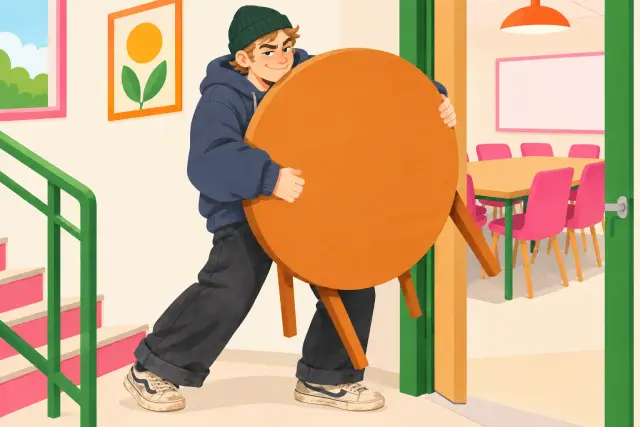
He found a round table for four in the office kitchen. Orest fetched a tape measure, measured the top, and decided six people would fit if they kept their laptops put away. He cleared the mugs, moved the chairs aside, and rolled the table on its edge toward the meeting room. He had to stop at the doorway: the top fitted through, but the legs caught on the frame. Orest turned the table sideways. Now the legs fitted, but the top hit the corridor wall—he had roughly half a palm’s width of clearance in either direction.

He took the table back to the kitchen, fetched a set of Allen keys, and unscrewed the legs. He carried the top in separately, holding it against his chest with both hands; the legs took another trip. He was on his knees tightening the final bolt when his manager returned from her call. She explained that a “roundtable” meant a discussion, and nobody cared what shape the furniture was. Orest gave the bolt another firm turn: leaving it loose just because the circumstances had changed would hardly be professional. Then he silently checked the table for wobbling.

Orest booked the ordinary rectangular table for the discussion and added a calendar note: “Discussion. Do not change the furniture.” Then he unscrewed the kitchen table’s legs again, carried everything back, and reassembled it during his lunch break. Tomorrow’s meeting was now fully arranged. When his colleagues returned from lunch, he finally sat down at the kitchen table with a sandwich. The Allen key lay beside him: he wasn’t putting it away before the first test under load.

0 2

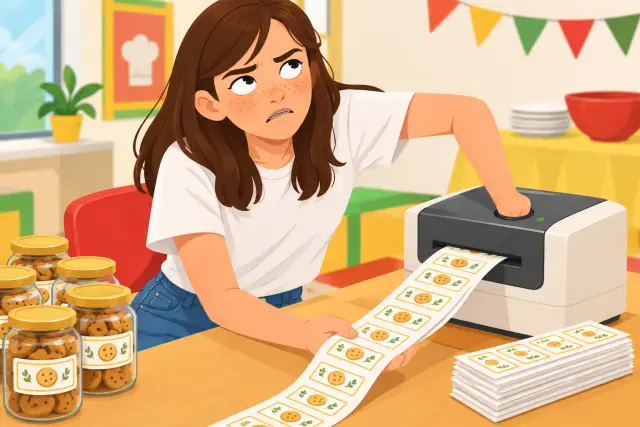
Paloma was feeding tape into the label printer when the app changed the number of copies to ten all by itself. She was standing at a table in the cooking club room, preparing labels for six jars of biscuits. Severyn, who ran the club, was setting out plates ahead of the parents' arrival. Paloma wanted to show him she could do more than just bake something—she could make the presentation look tidy, too. So she had borrowed his little label maker. Handwriting didn’t feel quite grand enough for biscuits she’d spent half the morning baking.

She had just changed the counter on the screen back to one and printed “Oat.” The label came out neatly, so Paloma decided to add the ingredients and a friendly “Enjoy!” But due to a glitch, every edit secretly reset the copy count back to ten. Busy perfecting the layout, she didn’t notice and tapped Print. The printer cheerfully produced ten identical long labels. Paloma stacked the extras beside her phone. Severyn had just cleared the middle of the table for her, and now she particularly wanted to put something there that looked better than a jar bearing a single, brief word.

For the next jar, she added a border, the ingredients, and a separate line about homemade butter. The counter jumped back to ten after her edit, but she had already tapped Print. A long stream of tape spilled over the edge of the table. Paloma caught it with both hands, rolled her eyes, and pressed the power button with her elbow. The printer finally stopped. She could have just picked up a pen, but Severyn had already placed the first labeled jar in front of the plates. She wanted the rest to match—just without a surplus of labels fit for an entire bakery.

Paloma found the reset button underneath the device and held it until the light blinked. The glitch was gone: the printer was finally producing one label at a time again. Unfortunately, the factory defaults also restored the smallest font size. With the parents already walking in, she simply shrugged, quickly printed all six names over again, and stuck them onto the jars.

She swept the spare labels into the trash bin, moved the jars right to the edge of the table so the tiny text could be read up close, and popped open the lids. At least the biscuits themselves were still a normal size.

0 1