
Live stories. Every single day.

Oh, you're here again, my friend. Have a seat and enjoy a good read.

We're still building the site — thanks for being here early.

Life Happens

Have you ever, like Elena, invented an urgent job at the dacha, then had to do it far more diligently than intended? One summer morning, she arrived at her aunt Marta’s for tea and some fresh peas. Two chairs stood beside the wooden shed, but her aunt was weeding the vegetable beds and suggested she join in. Elena had already crouched beside the weeds when she decided this was rather an ambitious start to her first morning off. She straightened up and pointed at the peas. “Sparrows. I’d better keep watch.”

There were no sparrows, but her aunt agreed at once: the lower pods were ripe, and it would be a shame to lose them to birds. Elena stood beside the bed and clapped a few times. When her aunt bent over the weeds, Elena stopped clapping. “Coming back, are they?” came a voice from behind the leaves. “Every time I turn away,” Elena replied, although she could see only stakes and her own feet. That meant she had to stay put. The chairs were only a few steps away, but she didn’t quite dare guard the peas sitting down yet: her aunt had seen how energetically she’d started.

Her aunt asked her to patrol the next row too, where more peas were filling out. Elena walked along, clapping every three steps, because after her account of the persistent sparrows, simply strolling no longer seemed sufficient. Her palms soon turned pink. She fetched a tea towel from beside the shed and began waving it over the bed. Meanwhile, her aunt brought tea directly to the peas: by Elena’s own account, she couldn’t leave her post. To take a drink, Elena tucked the towel under her arm, but her aunt glanced over, and she had to start waving again.

When an actual sparrow finally landed on a stake, Elena was almost pleased. She waved the towel, and the bird flew off. Now she was truly guarding the peas rather than pretending to be busy, so she moved a chair into the shed’s shade, where she could see both rows. “I made them up at first, to get out of weeding,” she told her aunt. “But I’m doing the job now. I’ll take the peas tomorrow too.” Elena set her tea beside the chair, picked a pod with permission, and laid the towel across her knees. Here she could sit, eat peas, and quite honestly leave the hoe alone.

1 7

Bohdan decided to follow instructions to the letter and, thanks to one strict warning, ended up washing his new kitchen tongs after every single pickle slice.

He was sitting at his kitchen table preparing a sandwich to go with his tea: bread, cheese, an open jar of sliced pickles, and his new metal tongs. The packaging printed a clear instruction: “Thoroughly wash after each use.” Being a methodical man, Bohdan took the rule literally.

The first slice landed on the cheese without incident. Bohdan stood up, dutifully washed the tongs under the tap, dried them with a towel, and returned for the second slice. After the second, he repeated the ritual, reasoning that picking up a single pickle definitely constituted a distinct “use.” By the third slice, he pulled his chair closer to the sink. By the fourth, he brought his plate over too—walking back and forth across the kitchen for a single click of the tongs felt like a waste of energy.

The dish towel was already soaked, yet the bread still had empty spots. Bohdan re-read the label carefully: thankfully, the manufacturer set no limit on the number of pickles allowed per use.

He tilted the jar, opened the tongs wide, and clamped down on a whole mound of slices at once. Pickles squirted out, splashing brine everywhere, so he squeezed harder. A generous portion finally crashed onto the bread, drenching the cheese in marinade.

Bohdan washed the tongs one last time, dried them, and put them away. But when he lifted the sandwich, the soggy bread sagged under the weight, and the pickles slid right back onto the plate. Bohdan sighed, set the tongs aside, grabbed a regular fork, and ate the pickles separately. He had followed the instructions to perfection, even if his tea was now completely cold.

0 4

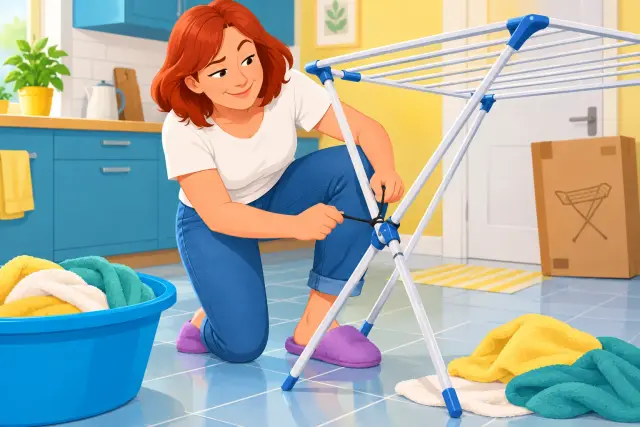
Olena set up her new freestanding drying rack in the middle of the kitchen and brought over a basin of washed towels.

She wanted to hang everything up quickly so she could enjoy her tea in peace. Her store review was going to be brief: “Unfolds, stands, thank you.” She even placed the cardboard packaging by the door to carry out right after her tea.

The first towel went onto the rails smoothly. Under the second, however, the plastic catch popped out of its slot, the legs collapsed, and the rack neatly deposited both towels onto the floor. Olena picked them up, spread the legs again, and forced the latch shut. As a test, she hung up one small hand towel—the structure held. She typed a line into her draft review: “Suitable for small loads.” But as soon as she added a heavy bath towel, the rack collapsed again, forcing her to delete the draft along with the wet patch on the tiles.

Hating the hassle of packing it up for a return, Olena decided to resolve the engineering flaw herself. Retrieving two heavy-duty cable ties from the kitchen drawer, she bound the leg joints tightly shut. Now the catch could pop out all it wanted; the frame was rock-solid. She hung all the towels and wet socks without an issue, updating her review: “After a minor adjustment, handles full loads effortlessly.”

When the laundry dried, Olena tried to fold the rack away, but the cable ties dutifully held firm. Cutting them meant restoring its automatic floor-depositing feature.

Shrugging, she simply carried the fully open rack into her shower cubicle. Now, before her evening shower, she moves it into the hallway, then parks it back over the drain afterward.

She opened the app and published her final review: “Three stars. Holds laundry well. Requires temporary evacuation when the owner needs to wash.”

0 8
Sponsored

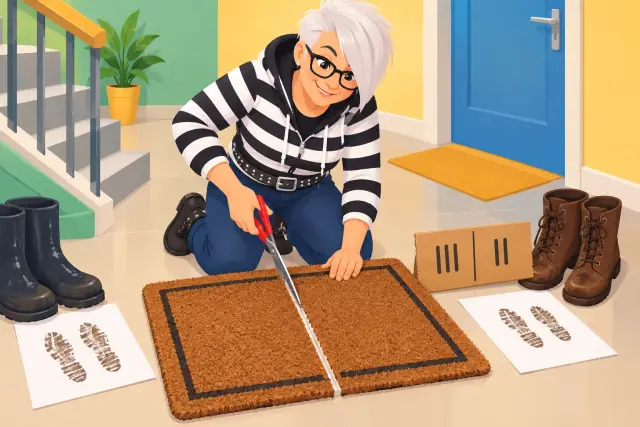
Grandma Stefaniia and her neighbor Ostap got into a heated dispute over whose half of the hallway doormat cleaned shoes better.

The shared mat outside their apartment had done its job quietly for years. But that rainy Thursday, Stefaniia returned from the market and decided to subject it to an honest test. Ostap, scraping his boots on the right, remarked that his section was clearly doing all the heavy lifting. Stefaniia promptly drew a chalk line down the middle, initiating a formal experiment.

For the first test, they each wiped a wet boot and stepped onto sheets of paper. Stefaniia’s print showed three dark streaks while Ostap’s had only two, prompting him to claim an immediate victory. Stefaniia conceded, but noted her side caught more drafts from the stairwell. She combed the mat's fibers with an old fork, extracting a button, two pine needles, and a coin—which they awarded to the mat as a performance bonus. On her second try, her boot left just one streak.

By next morning, the mat began migrating down the hall as Ostap nudged it to avoid "her dust" and Stefaniia pushed it back. Tired of the passive-aggressive tug-of-war, Stefaniia retrieved her heavy tailor scissors, sliced the mat right down the chalk line, and secured her half to the floor with double-sided tape.

A final test after an evening downpour settled the score. Stefaniia’s half stayed anchored, removing every grain of sand, while Ostap’s slid toward the radiator along with his boot.

Stefaniia mentally awarded her side top marks for grip and a single point for neighborly diplomacy, leaving the narrow gap between their mats as an official, non-negotiable border.

0 8

Giulia just wanted to wash her hands in the library restroom, but she ran into a new automatic soap dispenser that operated by its own peculiar rules: it dispensed soap only after she pulled her hand away.

She held her palm under the nozzle—silence. She moved closer and waited. But the moment she sharply withdrew her hand, the device spat a glob right into the empty sink. Her second attempt was strategic: hand under the sensor, a brief pause, a quick retreat. This time, the soap landed directly on her sleeve. The machine clearly acknowledged her presence, but refused to cooperate normally.

For her third attempt, Giulia placed one hand underneath and the other to the side to catch the drop. When nothing happened, she leaned in close to inspect the LED light. At that exact second, the dispenser triggered and squirted soap right onto her glasses.

Groping blindly, she rushed to the touchless tap, discovering it only flowed if she continuously waved her free hand in front of it. From the side, it looked as though she was tearfully bidding an overly dramatic farewell to someone.

Drawn by the commotion, the librarian walked in with paper towels and immediately solved the mystery: the sensor housing had been installed backward during morning maintenance.

Giulia thoroughly rinsed her glasses, spun the sensor around the right way, and held out her palm once more—the soap dropped neatly into her hand. Finally, she brought her soapy sleeve to the faucet, waved her other hand to trigger the water, and washed her cuff. Leaving the library, she decided to stick to traditional soap bars from then on—at least until her next restroom visit.

0 65

Bohdan went to the supermarket for just milk and tea, but a faulty shopping cart decided to design his weekly menu on its own.

The front left wheel was jammed at an angle, so instead of moving straight, the cart immediately veered right into the produce section. Trying to correct its path, Bohdan yanked the handle, accidentally snagged a display, and sent a mesh bag of potatoes scattering across the floor. Gathering them up, he sighed and tossed them into the basket: returning them after such an ordeal felt overly formal.

At the dairy section, he had to juggle holding the door open with one hand while keeping the cart from wedging itself under a shelf. He managed to grab his milk, then jammed the tea box between the potatoes so it wouldn't slide around the empty cart.

To counteract the alignment issue, Bohdan placed a five-liter jug of water on the right side as a counterweight. The cart finally went straight, but now gathered alarming momentum. In the household aisle, the jug shifted, the cart veered sharply, and knocked down a tower of paper towels. Pinning the jug with his knee, Bohdan gathered the towels and added them to his load.

Then he tried a new approach: stepping in front of the cart, he pulled it behind him. Backward, it rolled smoothly and effortlessly.

Glancing over his shoulder, Bohdan guided it to the checkout and paid for his unexpected haul. That evening, he posted a review on the store’s page: “Spacious, sturdy, creates its own menu. Struggles going forward, flawless in reverse.” He awarded four stars and poured himself a glass of water. At least one impulse buy was already justifying its place on the receipt.

0 35