
Live stories. Every single day.

Oh, you're here again, my friend. Have a seat and enjoy a good read.

We're still building the site — thanks for being here early.

Office Life

“How round does the table need to be?” Orest asked.

Orest, the office administrator, took the name of tomorrow’s discussion literally and started looking for round furniture. He was in the meeting room, where he had only meant to set up places for six colleagues. His manager had announced a “roundtable,” asked him to arrange everything, and left for a call without hearing his question. A rectangular table stood in the middle of the room. Orest ran his palm along a sharp corner: fine for an ordinary meeting, apparently no longer suitable for tomorrow’s.

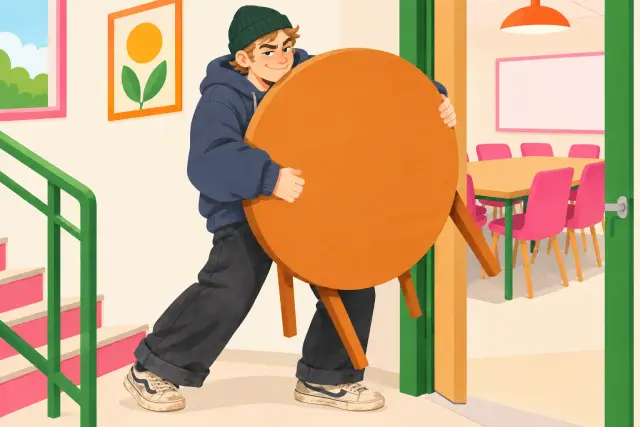
He found a round table for four in the office kitchen. Orest fetched a tape measure, measured the top, and decided six people would fit if they kept their laptops put away. He cleared the mugs, moved the chairs aside, and rolled the table on its edge toward the meeting room. He had to stop at the doorway: the top fitted through, but the legs caught on the frame. Orest turned the table sideways. Now the legs fitted, but the top hit the corridor wall—he had roughly half a palm’s width of clearance in either direction.

He took the table back to the kitchen, fetched a set of Allen keys, and unscrewed the legs. He carried the top in separately, holding it against his chest with both hands; the legs took another trip. He was on his knees tightening the final bolt when his manager returned from her call. She explained that a “roundtable” meant a discussion, and nobody cared what shape the furniture was. Orest gave the bolt another firm turn: leaving it loose just because the circumstances had changed would hardly be professional. Then he silently checked the table for wobbling.

Orest booked the ordinary rectangular table for the discussion and added a calendar note: “Discussion. Do not change the furniture.” Then he unscrewed the kitchen table’s legs again, carried everything back, and reassembled it during his lunch break. Tomorrow’s meeting was now fully arranged. When his colleagues returned from lunch, he finally sat down at the kitchen table with a sandwich. The Allen key lay beside him: he wasn’t putting it away before the first test under load.
0 2

“I’ll give up my desk for just one interview,” Béatrice told herself, but she unexpectedly lost her workstation for the entire day.

She was planning to check invoices in the open-plan office when a colleague from HR needed a quiet spot for an urgent video call. The meeting room was occupied, and Béatrice’s desk sat the farthest from the noisy corridor. Béatrice agreed to swap for half an hour, gathered her laptop and mug, and moved to her colleague’s desk right next to the kitchen.

Someone was grinding coffee there. Béatrice enlarged the numbers on her screen as if that might help her read them over the clatter of dishes. When the first call ended, her colleague asked for twenty more minutes. Then she inadvertently posted in the main work chat that she had discovered an ideal spot for calls. By lunchtime, four back-to-back interviews were on her schedule.

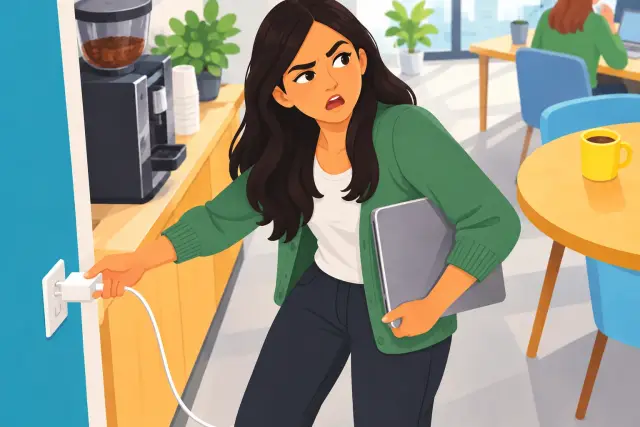
Going back to retrieve her charger, Béatrice found a printed sign-up sheet on her own desk and a pen laid beside her keyboard.

Realizing she wouldn't be getting her desk back anytime soon, she remembered the tiny archive room down the hall. It held a few storage boxes, but it had an outlet, a window, and a real door. With her manager’s permission, Béatrice neatly shifted the boxes to a lower shelf, plugged in her laptop, and shut the door. In the quiet, she checked a complex invoice on the first try.

When her colleague came to return the desk that evening, Béatrice simply smiled and asked to leave things as they were. She moved a small plant to her new windowsill, confirmed the permanent relocation, and closed the door once more. The coffee machine was further away now, but Béatrice was more than happy with that distance.

0 10

“I’m resting my voice today.”

Mateo made that up to avoid talking about his weekend at the office meeting, but now he had to stay quiet afterward, too. He was sitting in the meeting room and only wanted to agree on a deadline for the report. His colleagues were there, along with his manager, Iryna, who started every Monday with a quick round of personal updates. When his turn came, Mateo touched his throat and pointed to his notebook. Iryna nodded and asked him to write at least a couple of words.

He wrote “Nice and restful” and was reaching for his cup when Iryna asked about the report. That answer took three lines. While he wrote, his colleagues waited politely, so Mateo began abbreviating words, then had to explain the abbreviations separately. When he ran out of blank pages, he picked up a small whiteboard and marker from beside the door. The meeting ended, but a colleague from sales caught up with him in the corridor with a follow-up question. Mateo raised the board again: a suddenly healthy voice would need explaining.

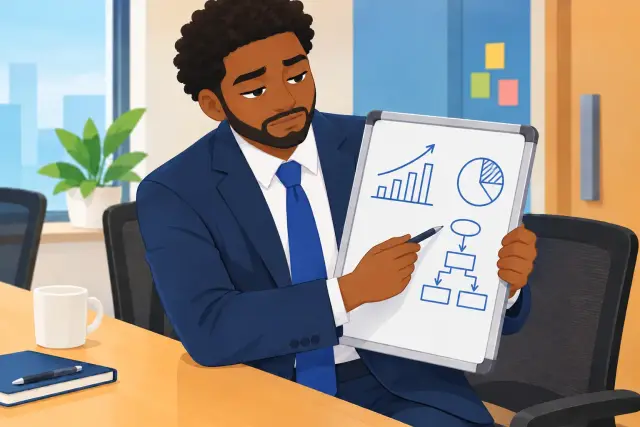
By lunchtime, he was carrying the board under his arm. In the kitchen, he wrote “Coffee, please” and showed it to a colleague by the kettle. When asked about sugar, he added “None” underneath. Back at his desk, he had to erase his order to draw the three stages of preparing the report for Iryna. She photographed the diagram: for once, the explanation fitted in a single picture. She asked him to keep the board for their next discussion. Mateo nodded, though his sleeve was already streaked with black because he had been wiping off the writing with a paper napkin while holding the board against himself.

At the last meeting, Mateo put down the marker and said in his normal voice:

“Actually, I just didn’t want to talk about my weekend. But I find it easier to work this way.”

He suggested starting every Monday with half an hour of written questions instead of personal updates. Iryna agreed to try it. The following Monday, Mateo set a clean board and a cloth beside his cup. In answer to the first question about the report, he wrote down the date, underlined it, and calmly finished his coffee while it was still hot.

0 10
Sponsored

Mateo agreed to water a single office ficus, but his colleagues interpreted this as an official handover of the department's entire botanical inventory.

On Monday, he sat in a half-empty office trying to finish his quarterly report. Marta from finance was heading on vacation and asked him to splash some water on her ficus by the window once a week. Mateo agreed—one pot felt entirely manageable. He checked the watering routine, set a Friday reminder, and returned to his spreadsheets.

On Tuesday, Marta posted a thank-you note in the main team chat, mentioning that "the plants" were now in safe hands. Triggered by that innocent plural, a sales colleague showed up an hour later with a cactus and a note: “Two drops every Wednesday.” Before Mateo could clarify, others dumped an orchid, a basil pot, and a jar containing an avocado pit onto his desk, before promptly switching to remote work for the rest of the week.

On Wednesday, Mateo scheduled a calendar event titled “Collect Your Plant” to return the greenery. Seeing the invite, four more colleagues brought in their home pots, assuming it was a corporate plant swap. On Thursday, three owners joined the meeting online via video link, staring at their pots through the screen while unable to physically take them back.

With the aisle blocked, the office coordinator brought over a two-tiered utility trolley. Mateo arranged the pots, labeled them with a marker, and wheeled them to the kitchenette.

On Friday, armed with a jug, a measuring spoon, and a towel, he watered everything over the sink and trimmed the dry leaves. He returned the ficus to his desk, parked the trolley by the window, and renamed the event “Plant Patrol.” Finally having cleared his desk, Mateo calmly finished the quarterly report.

2 13

Taras usually worked remotely, but on Wednesday he decided to come into the company’s downtown open-space office for a change of scenery. The office operated on a hot-desking system: employees booked workstations through an app, while unreserved tables displayed double-sided plastic signs reading “AVAILABLE DESK.”

He took a spot by the window, opened his laptop, and shifted the sign to the edge of the desk to make room for his coffee. From the corridor, the sign angled so that the first word blocked the second, leaving only a bold “AVAILABLE” visible. In a corporate culture perpetually strapped for resources, that was more than enough.

A sales manager approached first, handing him a printout: “Taras, take a quick look at this presentation, since you’re available anyway!” Taras explained that the desk was available, not him, but she just smiled, left the file, and promised to return in fifteen minutes. Next came an accountant with a financial spreadsheet, followed by a designer asking him to evaluate three shades of blue for a new landing page.

After every visitor, Taras laid the sign flat, but an office manager passing by kept standing it upright again: hot-desking rules required every workstation’s status to be clearly visible from a distance.

By lunchtime, a polite queue had formed beside his desk. Taras turned the sign toward the window, but his colleagues simply walked around the table and lined up on the other side. He then hid it in a drawer. Ten minutes later, the administrator sent him a message in the team chat asking him “not to obscure official signage in unreserved zones.” Taras sighed, retrieved the sign, put it back, and opened his calendar to block out time for sign-ups, realizing that fighting open-space logic on his own was a losing battle.

The following Wednesday, Taras came to the office again. He placed “AVAILABLE DESK” right in the middle of the table and added a sheet next to it reading “Available Taras: 3:00 PM–4:00 PM,” complete with a sign-up sheet. His coworkers appreciated the structured approach and quickly filled the slots: the presentation, the report, the three shades of blue.

At four o'clock sharp, Taras crossed out the final name, tucked both signs into the drawer, and moved to the neighboring desk he had pre-booked in the app. There, he opened his own task list, finished his still-warm coffee, and finally settled in to work under the dependable protection of the word “OCCUPIED.”

0 60

Tamara was leading an important online meeting from an empty office, but the motion sensors stubbornly assumed the building was deserted.

She had to present the new budget to upper management, so she set up in a glass conference room, placed her laptop on the long table, and clicked “Join.” Beyond the glass walls sat dark rows of desks and the coffee machine where she had already grabbed two double espressos for extra stamina.

On the third slide, the lights abruptly went out. Tamara apologized to the twelve faces on her screen, stood up, and waved her arms broadly. The sensor caught the movement, and the overhead lights flickered back on. But two minutes after she sat down, the room plunged into darkness again—the motion sensor simply refused to register a motionless person as an active employee. Tamara had to pace back and forth near the door while continuing her financial breakdown on the fly.

To stop pacing, she shifted her laptop closer to the sensor, where raising her arm every few minutes was enough. However, the video meeting software recognized the gesture and triggered the digital “Raise Hand” feature every time. The host kept interrupting: “Tamara, do you have a question?” She lowered her digital hand, returned to the slide, and waved her real hand a minute later as the lights began to dim again.

Finally, Tamara found a workaround: she took out her phone, switched on the flashlight, and pointed the beam at her face. No more gesturing was needed. She calmly walked through the final slides, got budget approval, and wrapped up right on schedule.

She turned off her flashlight, closed her laptop, and walked out. Behind her, the lights went dark once more—only this time, Tamara didn't bother proving her existence to the empty office.

0 12